Quiet Nerves ingredients and label
Six named ingredients, one front panel, and a clear line between what the label says, what the seller says and what general references say.
What the label shows
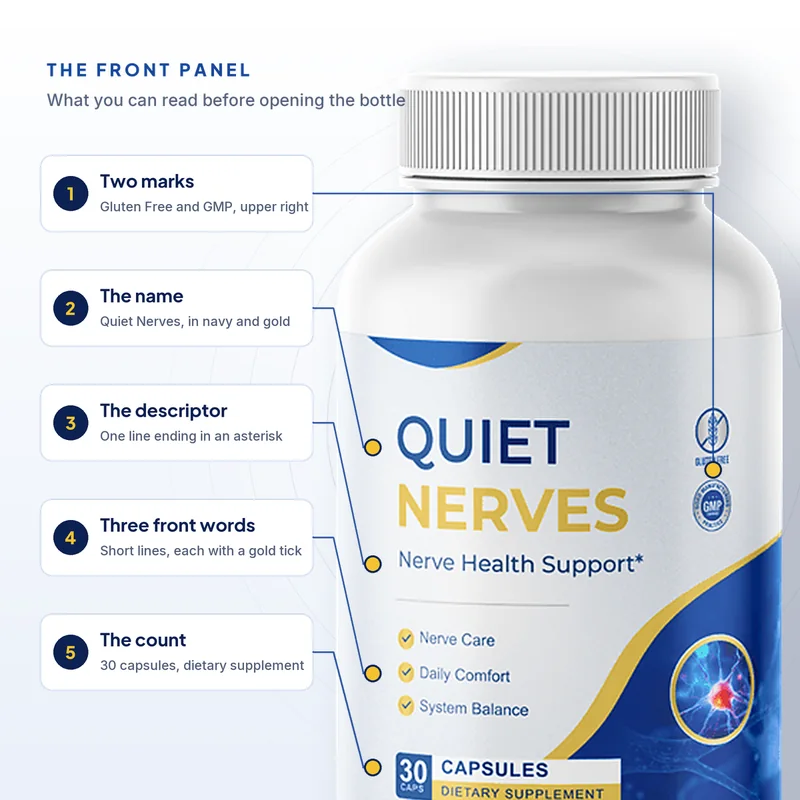
The front of the Quiet Nerves bottle shows five things: the name; the descriptor “Nerve Health Support”*; three short lines, Nerve Care, Daily Comfort, System Balance; two small marks, Gluten Free and GMP; and the count, 30 capsules, with the words “dietary supplement”.
The asterisk matters. On a supplement label it points to the statement that the claim has not been evaluated by the Food and Drug Administration and that the product is not intended to diagnose, treat, cure or prevent any disease.
What is not shown online: the Supplement Facts panel
Neither the brand page nor the order page displays the Supplement Facts panel. That means the serving size as printed, the amount of each ingredient per capsule, the percent Daily Value for magnesium and the “other ingredients” (capsule shell and fillers) are not available before purchase.
We do not fill that gap with estimates. The seller’s stated serving is one capsule a day, and the six ingredient names below come from the brand page. Everything numeric about the formula is on the bottle.
When your bottle arrives, read the panel before the first capsule. If it differs from anything on this page, the bottle is right.
The six named ingredients
- Magnesium GlycinateA mineral, bound to the amino acid glycine
- Alpha Lipoic AcidA sulfur-containing compound the body also makes itself
- Butcher’s BroomA shrub (Ruscus aculeatus) whose root is used in herbal products
- L-CarnitineA compound made from amino acids and found in most cells
- TurmericA root extract; standardized to 95% curcuminoids, according to the seller
- Coenzyme Q10A compound the body makes and uses in its cells
Magnesium Glycinate
- What it is
- A mineral, bound to the amino acid glycine.
- What the seller says
- It calls magnesium glycinate the cornerstone of the formula and a gentle, well-absorbed form of magnesium.
- What general references say
- Magnesium is a nutrient the body needs for many processes, including regulating muscle and nerve function. Adults are advised to get roughly 310 to 420 mg a day from all sources, and the upper limit for magnesium from supplements and medicines is 350 mg a day for adults. High supplemental intakes can cause diarrhea, nausea and cramping, and magnesium can interfere with some antibiotics and osteoporosis medicines (NIH Office of Dietary Supplements).
- What cannot be concluded
- How much magnesium one capsule supplies, and therefore what share of a day’s intake it covers. The NIH sheet lists aspartate, citrate, lactate and chloride as better-absorbed forms and does not discuss glycinate.
Alpha Lipoic Acid
- What it is
- A sulfur-containing compound the body also makes itself.
- What the seller says
- It describes alpha lipoic acid as an antioxidant that is both water- and fat-soluble.
- What general references say
- The NIH’s complementary health center groups alpha-lipoic acid with supplements for which there is weak evidence of a possible benefit in people with diabetes-related nerve problems, and says the studies differ too much in size, dose and design to support clear conclusions (NCCIH).
- What cannot be concluded
- Whether the amount in a capsule resembles the amounts used in those studies, and whether any of that research applies to people without diabetes.
Butcher’s Broom
- What it is
- A shrub (Ruscus aculeatus) whose root is used in herbal products.
- What the seller says
- It describes butcher’s broom as a traditional European botanical associated with circulation in the legs.
- What general references say
- We did not find a current NIH consumer fact sheet for butcher’s broom, so we cite none. Its use is traditional, and that is as far as we can responsibly go.
- What cannot be concluded
- Anything about its effect in this product. Tradition is not evidence about a finished capsule.
L-Carnitine
- What it is
- A compound made from amino acids and found in most cells.
- What the seller says
- It describes L-carnitine as a compound involved in cellular energy whose levels decline with age.
- What general references say
- Carnitine helps turn food into energy. Healthy people make all they need, so there is no recommended daily amount, and the body absorbs carnitine from food much better than from supplements. Research on its health effects is mixed. Doses of 3 grams a day or more can cause nausea, cramps and a fishy body odor (NIH Office of Dietary Supplements).
- What cannot be concluded
- Whether a single capsule shared with five other ingredients contains a meaningful amount. A capsule cannot hold anything close to 3 grams.
Turmeric
- What it is
- A root extract.
- What the seller says
- It says the turmeric is a standardized extract delivering 95% curcuminoids.
- What general references say
- Curcuminoids, which include curcumin, are the compounds turmeric’s effects are usually attributed to. NIH’s summary is that we do not know enough to conclude definitively that turmeric or curcumin is beneficial for any health purpose. Conventional oral turmeric is likely safe in recommended amounts for up to 2 or 3 months; stomach upset can occur, and turmeric supplements may be unsafe in pregnancy (NCCIH).
- What cannot be concluded
- The milligrams of extract per capsule. “95% curcuminoids” describes the extract’s strength, not how much of it you get.
Coenzyme Q10
- What it is
- A compound the body makes and uses in its cells.
- What the seller says
- It describes coenzyme Q10 as a compound involved in cellular energy that the body makes less of with age.
- What general references say
- CoQ10 is naturally present in the body, with the highest levels in the heart, liver, kidneys and pancreas. No serious side effects have been reported; mild ones such as insomnia or digestive upset may occur. It may interact with the blood thinner warfarin and with insulin (NCCIH).
- What cannot be concluded
- Any effect on nerves specifically. NCCIH’s review covers heart conditions, statin-related muscle pain and Parkinson’s disease, with mostly inconclusive or negative findings.
Three layers, kept apart
| Layer | What it covers | How far it goes |
|---|---|---|
| The label | Name, descriptor with asterisk, three short lines, two marks, 30 capsules | Read by us from the bottle image |
| The seller | Six ingredient names, 95% curcuminoids, one capsule a day, gluten-free, made in the USA | Stated on the brand page; not independently verified |
| General references | What each ingredient is, typical cautions and interactions | About the ingredient in general, never about this capsule |
| Not available | Amount of each ingredient, other ingredients, any trial of the finished product | Printed on the bottle, or not published at all |
Swipe sideways to see every column.
Allergens, capsule shell and storage
The label carries a gluten-free mark and the seller states “100% Gluten-Free”. No other allergen statement is published online, and the capsule shell material is not stated. If you avoid gelatin, soy, dairy or anything else, check the “other ingredients” and allergen lines on the bottle, or ask support at [email protected] before ordering.
For storage, the seller says each bottle carries an expiration date and that shelf life is typically 2 years from manufacture. Keep the bottle closed, away from heat and moisture, and out of the reach of children.
A five-minute label check when the bottle arrives
Seal
The safety seal under the cap should be intact. If it is not, do not use the bottle; contact support.
Serving size
Confirm it says one capsule, matching the seller’s directions.
Six names
Find all six ingredients and note the amount next to each.
Magnesium
Look at its percent Daily Value and add it to any magnesium you already take; the supplemental upper limit for adults is 350 mg a day.
Other ingredients
Check the capsule material and any allergen statement.
Dates
Note the expiration date, then write your purchase date on the box.
Sources
- Product source: the Quiet Nerves brand page and order page, the seller’s refund, shipping and contact pages, and the BuyGoods checkout, read on November 20, 2026.
- General reference: NIH Office of Dietary Supplements. Magnesium: Fact Sheet for Consumers.
- General reference: National Center for Complementary and Integrative Health. Diabetes and Dietary Supplements: What You Need To Know.
- General reference: NIH Office of Dietary Supplements. Carnitine: Fact Sheet for Consumers.
- General reference: National Center for Complementary and Integrative Health. Turmeric: Usefulness and Safety.
- General reference: National Center for Complementary and Integrative Health. Coenzyme Q10.
- General reference: U.S. Food and Drug Administration. Questions and Answers on Dietary Supplements.
- Our own arithmetic: totals, cost per day, pack comparisons and refund examples are calculated from the prices and policy figures above.